"My Aunt Had Breast Cancer, So I Will Probably Get It Too"
"My aunt had breast cancer, so I will probably get it too." It is one of the most common statements patients make in the clinic, and one of the least accurate. Family history matters, sometimes a great deal, but it is not a verdict. Most women with an affected relative never develop breast cancer, and a considerable number of women who do develop it have no family history at all.
What has changed in the last decade is that we can now identify, with a simple test, the families in which the risk is genuinely inherited. And that information is not merely interesting. It changes how a woman is screened, how a patient is treated, and how her relatives can protect themselves.
Hereditary vs. Sporadic Breast Cancer
Most breast cancers are sporadic, meaning they arise from gene changes that happen during a person's lifetime. Roughly 5 to 10 percent are hereditary, caused by a harmful variant (mutation) in a gene that is passed down in the family.
The best-known of these genes are BRCA1 and BRCA2. Everyone carries two copies of each. In their normal state, they help repair damaged DNA and prevent cells from growing out of control. When one copy carries a harmful variant, this protective system is weakened, and the lifetime risk of cancer rises.
What Does a BRCA Mutation Actually Mean?
The numbers vary between studies, but as a broad guide:
• The average woman has roughly a 1 in 8 lifetime risk of breast cancer.
• A woman with a harmful BRCA1 or BRCA2 variant has a lifetime risk in the region of 45 to 70 percent or higher.
• The risk of ovarian cancer is also significantly increased, along with smaller increases in the risk of pancreatic and, in men, prostate and breast cancer.
• BRCA1-related breast cancers are more often triple-negative and tend to occur at younger ages.
It is crucial to remember that a mutation means increased risk, not certainty. A carrier may never develop cancer, and there are effective ways to reduce risk.
Other genes also matter, including TP53, PALB2, CHEK2, ATM, PTEN, and CDH1, which is why many laboratories now offer multi-gene panel testing rather than testing for BRCA alone.
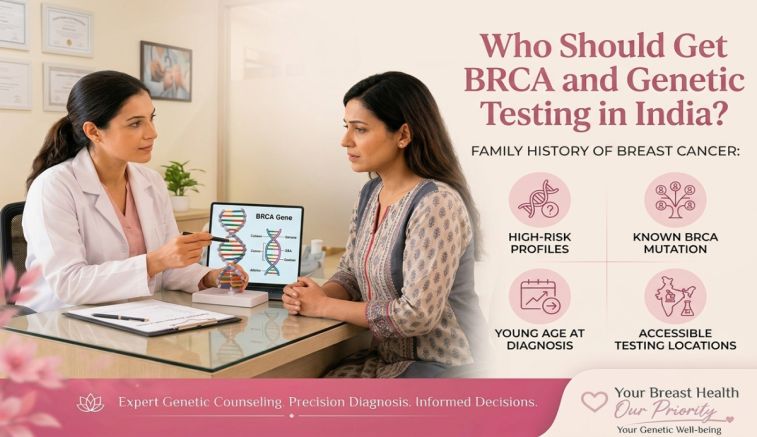
Who Should Consider Genetic Testing?
Guidelines vary slightly between organisations, but testing is generally worth discussing if you or a close relative have any of the following:
• Breast cancer diagnosed at age 45 to 50 or younger
• Triple-negative breast cancer diagnosed at or below about 60
• Cancer in both breasts, or two separate primary breast cancers
• Ovarian, fallopian tube, or primary peritoneal cancer at any age
• Male breast cancer
• Pancreatic or metastatic prostate cancer in the family
• Two or more close relatives on the same side of the family with breast, ovarian, pancreatic, or prostate cancer
• A known BRCA or other gene mutation in the family
• Certain ancestry-related risk factors, such as Ashkenazi Jewish ancestry
• A breast cancer patient for whom the result would change treatment decisions
If you are unsure, bring a rough family tree to your consultation. Include both your mother's and father's sides. The father's side is frequently forgotten, though BRCA mutations can pass through fathers as easily as mothers.
Why Does This Matter Even After a Cancer Diagnosis?
For a patient already diagnosed with breast cancer, genetic testing can influence treatment in several ways:
• It can guide surgical choices: A woman with a BRCA mutation may prefer a bilateral mastectomy rather than breast conservation, because her risk of a second cancer is higher.
• It identifies targeted drug eligibility: It highlights patients who may benefit from PARP inhibitors, a targeted class of drug used in selected BRCA-related cancers.
• It alerts the family: If you carry a mutation, each of your siblings and children has a 50 percent chance of carrying it too.
What Does the Test Involve?
Genetic counselling first: A good counselling session explains what the test can and cannot tell you, what the possible results mean, and how they might affect you and your family. It is not just a formality, and it is a good idea to have it before and after the test.
The sample: A simple blood or saliva sample, with no fasting needed.
Turnaround: Results typically take a couple of weeks, depending on the laboratory.
There are three possible outcomes:
- Positive: A harmful variant is found.
- Negative: No harmful variant is found. This is most reassuring when a known family mutation has been tested for specifically and is absent. If the test is negative in a family where no mutation has been identified, residual risk may remain, and screening still depends on your overall family history.
- Variant of Uncertain Significance (VUS): A change is found, but its meaning is unclear. A VUS should not be used to make surgical decisions, and it is typically reclassified as science progresses.
If You Test Positive: Your Options
A positive result is not a diagnosis, and it opens a clear set of choices.
Enhanced Surveillance: This typically means starting yearly breast MRI in the mid-20s to 30, adding mammography from about 30 to 40, and clinical breast examinations every 6 to 12 months. The schedule is personalised to the gene and the family history.
Risk-Reducing Surgery:
• Risk-reducing mastectomy lowers the risk of breast cancer by a very large margin (more than 90 percent in many studies) and can be combined with reconstruction.
• Risk-reducing removal of the ovaries and fallopian tubes is recommended in BRCA carriers, usually between about 35 and 45, depending on the gene and whether childbearing is complete. It lowers ovarian cancer risk substantially.
Medication: In selected women, risk-reducing medicines can be discussed.
Lifestyle: Maintaining a healthy weight, regular exercise, and limiting alcohol are sensible for everyone, though they do not cancel a genetic risk.
None of these choices has to be made in a rush. The right timing depends on age, family plans, and personal preference.
Telling the Family
One of the hardest parts of a positive result is deciding whom to tell. This process, known as cascade testing, is highly valuable. Once the specific mutation in a family is known, relatives can be tested for that single change, which is simpler, and the ones who test negative can be spared intensive surveillance. Those who test positive gain the chance to prevent cancer or catch it early.
Common Myths
"No one in my family has had cancer, so I can't carry a mutation."
Small families, early deaths from other causes, and limited medical records can hide a pattern. Mutations can also arise newly in an individual.
"A negative test means I'll never get breast cancer."
No test can promise that. Most breast cancers are not hereditary, and screening remains important.
"If I carry the gene, I will definitely get cancer."
No. Risk is high but not 100 percent, and it can be actively reduced.
"Genetic testing is only for women."
Men carry and pass on these variants too, and male carriers have their own screening needs.
A Final Word
Genetic testing is not about predicting the future. It is about taking away uncertainty so that you and your family can make better decisions, earlier. If breast or ovarian cancer runs in your family, or if you were diagnosed young, a conversation about genetic testing is worth having.
Dr. Rohan Khandelwal offers risk assessment and guidance on genetic testing at CK Birla Hospital for Women, Block J, Mayfield Garden, Sector 51, Gurugram. Call 0124 488 2200 or +91 79882 52759 to book a consultation.
This article is for general information and does not replace a personal medical consultation.
Frequently Asked Questions
Testing for hereditary cancer genes is generally done in adults, because screening and risk-reducing steps start in adulthood.
Policies differ, and it is wise to understand your insurance terms before testing. A counsellor can guide you.
Cost depends on whether single-gene, targeted-family or multi-gene panel testing is chosen, and it has become more accessible over time. The clinic can guide you to appropriate laboratories.