Written by Dr. Rohan Khandelwal, Breast Surgeon, CK Birla Hospital for Women, Gurugram.
Quick answer: Most breast cancers are not inherited, but some are, and knowing early can change screening, surgery and even drug choices. Consider genetic counseling if you were diagnosed young, have triple-negative disease, or have several relatives with breast, ovarian, pancreatic or prostate cancer, or a male relative with breast cancer. Testing is a blood or saliva sample. Start with a counselor, not a kit.
Every October, Breast Cancer Awareness Month fills the calendar with pink ribbons, walks and reminders to "get checked." Those messages matter. But awareness only helps when it turns into a specific action, and for many families the most useful one costs nothing: sit down and map your family's cancer history. This guide explains what that history can tell you, who should consider genetic testing, and what happens after the result.
What does "hereditary breast cancer" mean?
Every cell carries two copies of genes such as BRCA1 and BRCA2, which help repair damaged DNA. When someone inherits a faulty copy, the repair system is weaker, and the lifetime risk of breast and ovarian cancer rises sharply. Over a lifetime, a BRCA1 or BRCA2 carrier's breast cancer risk is several times that of an average woman, and ovarian cancer risk rises too. Exact figures vary by study and family, so a genetic counselor should give you a personalised estimate.
Two points surprise many families:
• It runs through fathers as well as mothers. A father's sister or mother with breast cancer counts as much as your mother's side.
• Men carry these genes too. BRCA changes, especially BRCA2, can cause male breast cancer and raise prostate and pancreatic cancer risk.
How common is it in India?
Western data suggest BRCA1/2 mutations explain roughly 4–6% of breast cancers in an unselected population. Indian data suggest the inherited picture is broader than BRCA alone. A 2026 IIT Madras study of 479 patients found that about 1 in 4 (24.6%) carried an inherited variant that raises cancer risk, but only 8.35% had BRCA1/2 changes. Most of the inherited risk came from other genes. The researchers argued for wider multi-gene testing instead of BRCA-only testing.
This matters in India because breast cancer here tends to appear earlier and more often as triple-negative disease. A North Indian study notes a median age of onset below 50 and triple-negative cancers of up to 30%. Both patterns are linked to higher chances of an inherited cause. (We cover the age pattern in Breast Cancer Under 40 in India.)
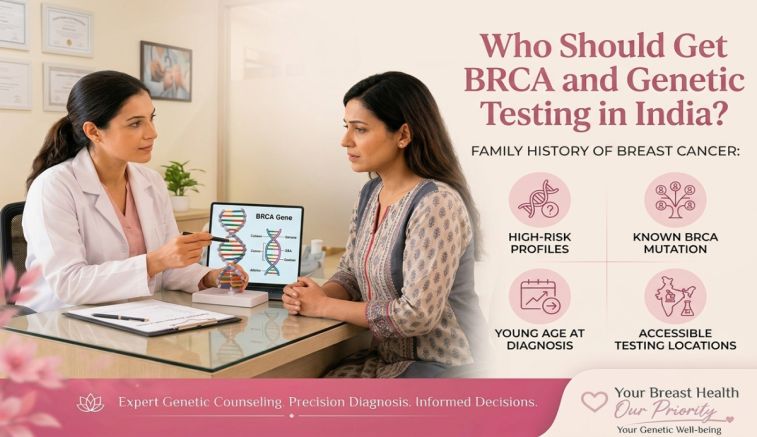
Who should consider genetic testing?
Guidelines differ slightly, but a referral for counseling is reasonable if any of these apply:
• Breast cancer diagnosed at 50 or younger
• Triple-negative breast cancer at any age up to 60
• Ovarian, fallopian tube or peritoneal cancer in you or a close relative
• Two or more close relatives with breast cancer, especially on the same side of the family
• Breast cancer in a man in your family
• Pancreatic or metastatic prostate cancer in a close relative
• A known BRCA or other pathogenic variant already found in your family
• Breast cancer in both breasts, or two separate cancers in one person
Relatives' ages at diagnosis matter as much as the number of cases. A grandmother diagnosed at 78 says far less than an aunt diagnosed at 38.
A caution on small families: researchers have found that when a family has few women, an inherited mutation can go unnoticed. People in that situation were about three times more likely to be carriers. If you have few female relatives, or limited information on one side, tell your doctor.
BRCA-only test or multigene panel?
Older testing looked only at BRCA1 and BRCA2. Panels now check BRCA plus other genes such as PALB2, TP53, CHEK2 and ATM in the same sample. Given the Indian findings above, a panel is often the better choice, since a BRCA-only test would miss most of the inherited changes found in the IIT Madras study. Your counselor can help you choose the panel. Prices vary widely between labs, so ask for a written quote.
If a relative has already been tested and a specific change was found, you may need only a single-site test for that exact change, which is usually cheaper.
What are the possible results?
• Positive (pathogenic variant): You carry a known risk-raising change. This is where a plan begins.
• Negative: No known change was found. This is reassuring, but it does not erase risk from family history or other causes. Screening still follows your overall risk.
• Variant of uncertain significance (VUS): A change was found, but its effect is unknown. It is not treated like a positive result, and its classification can be updated as research grows.
A result belongs in a conversation with a specialist, not on a lab report alone. Home genetic kits that give risk figures without family history can mislead. One report warns they may inflate risk and lead to unnecessary preventive surgeries.
If you test positive: what changes?
A positive result is information you can act on. Options depend on your age, family and preferences:
• Closer surveillance: Carriers usually start earlier and use MRI alongside mammography. (See Mammogram vs Ultrasound vs MRI for how the tests differ.)
• Risk-reducing surgery: Some women choose preventive mastectomy, often with breast reconstruction, and some consider removing the ovaries and tubes once childbearing is complete. These are personal decisions made over time, never in a rush.
• Treatment choices after a cancer diagnosis: In someone already diagnosed, the result can shape the surgical plan (for example, lumpectomy versus mastectomy) and whether targeted medicines are suitable. Research suggests testing results can modify the treatment plan of mutation carriers.
• Cascade testing for relatives: Each child of a carrier has a 50% chance of inheriting the same change. Once the family variant is known, relatives can take the simpler single-site test.
Being a carrier means higher risk, not certainty. How much higher can depend on the wider family. A 2026 study found the same BRCA result carried different risk depending on a woman's family cancer history.
Does a negative family history mean you're safe?
No. Most breast cancers occur in women without a family history, and screening is for everyone. Some figures put it at around 70-80% of breast cancers in women with no family history. Genetic testing is one tool for a specific group, not a replacement for regular check-ups.
An October action plan: from awareness to action
This month, try these five steps:
1. Draw your family tree. Note every case of breast, ovarian, prostate and pancreatic cancer on both sides, with the age at diagnosis.
2. Ask the older relatives. Often someone has already been tested or knows the type of cancer. Ask kindly and gently.
3. Book a clinical breast examination and, if you are in the screening age band, a mammogram.
4. Bring the family tree to your appointment. A one-page chart saves a lot of time.
5. Share what you learn. Siblings and cousins may be at risk even if they have no symptoms.
If you notice a lump, nipple discharge or a skin change, don't wait for a pink-ribbon event. Book a consultation.
When to see a breast specialist
See a specialist if your family history matches any point in the checklist above, if you are younger than 40 and a close relative had breast or ovarian cancer, or if you have a new breast symptom. At Breast Health, Dr. Rohan Khandelwal can review your history, plan the right tests and breast cancer treatment, and refer you for genetic counseling where needed.
Appointments: +91 79882 52759 | CK Birla Hospital for Women, Block J, Mayfield Garden, Sector 51, Gurugram.
Frequently Asked Questions
No. Most women with an affected relative never develop breast cancer, and most cases occur in women with no family history. It does mean your risk should be assessed carefully.
There is no single age. Testing is based on your history, not a birthday. Adults with a qualifying personal or family history can be tested, and testing of minors is generally avoided unless there is a medical reason.
It uses a blood or saliva sample. The emotional side is bigger than the physical one, which is why counseling before and after the test is recommended.
Yes. Men can carry and pass on BRCA changes, and BRCA2 in particular is linked with male breast and prostate cancer.
Not entirely. A negative result lowers concern about a specific inherited cause, but family history can still raise risk. Your doctor will set your screening plan based on both.
Adult relatives can be offered single-site testing for your exact change. Each child of a carrier has a 50% chance of carrying it. A counselor can guide who should be tested and when.
No. Many carriers choose surveillance, and preventive surgery is an option, not a requirement.
Sources and further reading
• IIT Madras germline breast cancer study coverage (Careers360, March 2026)
• Study summary: breast cancer genetic risk in India (March 2026)
• Profile of pathogenic mutations in breast cancer patients at a North Indian centre (PMC)
• Family history and BRCA risk, JAMA Network Open study via HealthDay (July 2026)
• Evaluation of family history in BRCA carriers (PMC)
• Home genetic testing and breast cancer risk (Healthline)
This article is for education and does not replace personal medical advice.