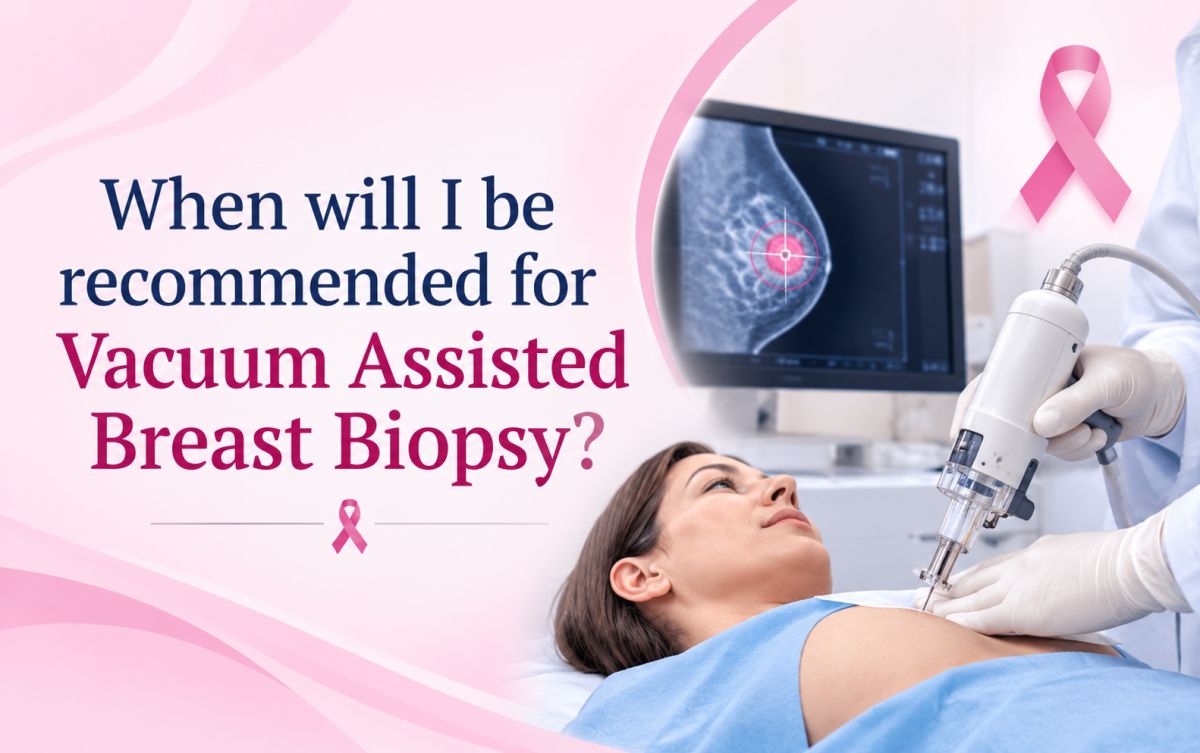
If you have had a scan of your breast and have found a small lump, or cluster of calcifications, it is possible that the lesion will be identified and we can use Vacuum Assisted Breast Biopsy to assist the doctor in taking samples from the breast.
If there is an area of concern identified on your ultrasound/mammogram, then your clinician may recommend that a biopsy is taken. In select cases, Vacuum Assisted Breast Biopsy can be used to take multiple samples from an area of concern. This is done through a small incision in the skin, usually with imaging guidance and local anaesthetic.
Whether you are offered a Vacuum Assisted Breast Biopsy will depend on a variety of factors, including what was seen on your scan, whether the area can be accessed safely, how much tissue needs to be taken and what your medical history is. It may be offered for certain types of lumps, architectural distortions or clusters of calcifications. It would not be suitable for all breast abnormalities and would not replace an operation if one was medically needed.
This guide will help you understand how Vacuum Assisted Biopsy will fit into your diagnostic process, what happens during the procedure and how to interpret the results.
What is a Vacuum Assisted Breast Biopsy?
A Vacuum Assisted Biopsy uses a specialised biopsy device that gently sucks tissue into the sampling chamber. A rotary cutting head will take samples. Multiple samples can be taken from a small incision in the skin. It can be performed with ultrasound guidance or stereotactic mammography.
Core needle biopsy can also be performed, taking samples from the tissue using a needle. Vacuum-assisted biopsy can be useful in taking larger amounts of tissue or multiple samples from one insertion. The decision to take a core needle biopsy, VABB or surgical biopsy should be based on the appearance on imaging and what you are trying to find out.
Minimally Invasive Breast Biopsy refers to the fact that the biopsy is taking tissue through a small incision. It is not without risk; you will not be able to completely remove all lesions and if the result is benign, you may still need follow up. The imaging and pathology results will need to be considered.
When will I be offered a VABB Procedure for my Breast Lump?
This may be offered if you have a lump or area of concern on your imaging and your clinician feels that a VABB is suitable to take samples. It may be suitable for certain small or well defined lesions, areas where having more tissue would help with diagnosis, or some mammographic abnormalities.
It may be used in very select cases to remove certain benign looking lesions. This will depend on the size, location, appearance on imaging and your preference. It will not be a definitive cancer operation. If the pathology comes back showing malignancy, atypia or any other findings, further procedures may be recommended.
You should ask what the aim of the procedure is. Are you having the biopsy to take a sample, remove a lesion that you believe is benign or to investigate an area of concern on your imaging? This will help to avoid any unrealistic expectations.
How will my doctor decide if a VABB is suitable?
Usually, the first thing your doctor will do is take a history and perform a breast examination. They will look at your relevant mammograms, ultrasounds and any relevant MRI findings. The radiologist or breast specialist will look at the location, size, shape and visibility of the lesion. They will also consider how it appears on imaging compared to your examination.
If you are being recommended for a biopsy, this will be stated in your imaging report with a BI-RADS category. This is a standardised scoring system to help communicate how concerned they are and what should happen next. This is not a diagnosis of cancer. Depending on the category, appearance on imaging and your clinical situation, the correct action will be taken.
They will also consider if you are taking any medications that thin your blood, have any bleeding disorders, allergies, if you could be pregnant, if you have had any previous breast procedures and if you can lie comfortably in the correct position. You should never stop taking your medications. Your treatment team will give you specific advice regarding medications, eating, travelling and preparing.
What happens during the VABB?
This is often performed with local anaesthetic. You will be asked to lie in a position that will allow safe access to the area. Your skin will be cleaned and local anaesthetic injected. The biopsy device will be guided to the area using imaging.
A small incision will be made in your skin and the vacuum assisted probe inserted. Samples will then be taken. Multiple samples may be taken and your clinician will be able to see where the probe is. In some instances, a small clip may be inserted to mark the biopsy site. This can help identify the area on future imaging, especially if part or all of the lesion has been removed.
Once samples have been taken pressure will be applied to reduce bleeding and a dressing applied. The tissue will be sent to pathology. The length of time will depend on the lesion, imaging and clinical situation. Your care team will tell you what you will feel during the procedure, how long your appointment will last and if you will need someone to go with you.
Will I feel pain, bruising and how long will I be recovering?
Most people will not feel any sharp pain during the procedure if there is enough local anaesthetic. Some people will feel some mild discomfort, bruising, swelling or a little bleeding. How much discomfort you feel will vary and depend on the area being biopsied and the amount of tissue being taken.
Your team will give you advice about keeping the dressing on, showering, exercising, lifting and pain relief. You may be advised to wear a supportive bra and apply a wrapped ice pack. Follow your clinician's specific advice.
If your bleeding does not stop with pressure, you begin to swell quickly, feel severe pain, the area becomes increasingly red/warm or you develop a fever/abnormal discharge, please contact your treating centre. This does not necessarily mean that something has gone wrong but you should have it assessed. If you are bleeding heavily, feeling faint or have any other urgent symptoms, please seek immediate medical attention.
Understanding your Pathology Results and Concordance
Your pathology results will tell you what the tissue looked like under the microscope. Results can be benign, show a high risk/atypical change or cancer. How this relates to you will depend on what the exact diagnosis was and if it explains what was seen on imaging.
One of the most important things to understand is concordance. This means that the pathology results are checked against your original scan and clinical findings. If there was an area of concern on imaging but your samples came back as normal tissue, then your team will need to decide if this is an adequate explanation for your scan. In some cases, further sampling or surgical removal may be recommended even if your biopsy did not show cancer.
A benign result should be understood in context. Ask when you will get your results, who will explain them to you, are they concordant with your imaging and what follow up will be required. Do not assume that a benign result means nothing further will be needed.
VABB vs Core Needle vs Surgical Biopsy
Each biopsy will help answer a slightly different question. Core needle biopsy is widely used and takes samples from an area of concern using a hollow needle. VABB uses a vacuum assisted device to take multiple samples. It can be useful if larger amounts of tissue are needed or for certain lesions. Surgical biopsy involves an operation to remove part/all of an area. It may be suitable if sampling is not possible, there is still discrepancy or the diagnosis needs to be managed surgically.
There is no universally ‘best’ option. A less invasive option can help to avoid an operation in some cases. However, if your pathology or clinical findings require a definitive operation, then this cannot be replaced. The most appropriate option will be the one that will give you a reliable answer safely.
What questions should I ask before my VABB?
What was seen on my imaging? Why am I being asked to have a biopsy? Why am I being asked for a VABB rather than a core needle/surgical biopsy? What imaging will be used to guide the biopsy? Will a clip be inserted? What are the potential complications? If I am on blood-thinning medication, what do I need to do? When will I get my results and how will they be explained? Who will explain if they are concordant with my imaging? What if the sample is inconclusive/atypical/malignant?
Asking these questions will help make your appointment more useful. If possible, take your previous scans.
Specialist Assessment at BreastHealth
A breast biopsy is part of a wider diagnostic process. It is important that the biopsy is carefully assessed and the results clearly interpreted. Patients in Gurgaon and the wider Delhi NCR area can find information about the relevant service at BreastHealth. You can also discuss your findings with Dr. Rohan Khandelwal.
Please bring your original imaging reports, imaging on CD or digital if available, any previous pathology reports, a list of medications and any previous breast procedures. The clinician can assess your findings, explain if a Vacuum Assisted Breast Biopsy is suitable and what alternatives may be available. Treatment should only be decided following an individual assessment.
Frequently Asked Questions
No. It is a minimally invasive biopsy using imaging guidance to take samples from your breast. It is not an open operation however, in some cases, selected benign lesions may be removed.
Sometimes selected small lesions can be removed; however, it is not guaranteed. This depends on the size, location, imaging and pathology of the lesion. Please clarify with your doctor if you are having the biopsy to take samples or remove the lesion.
Local anaesthetic will be used to numb the area. You may feel pressure or vibrations. There may be some temporary soreness or bruising.
This will depend on the lab and if further tests are required. Please enquire with your treating centre.
Yes. The tissue will be analysed by a pathologist. This can identify benign changes, atypical changes, or cancer. The results should be checked to ensure they are concordant.