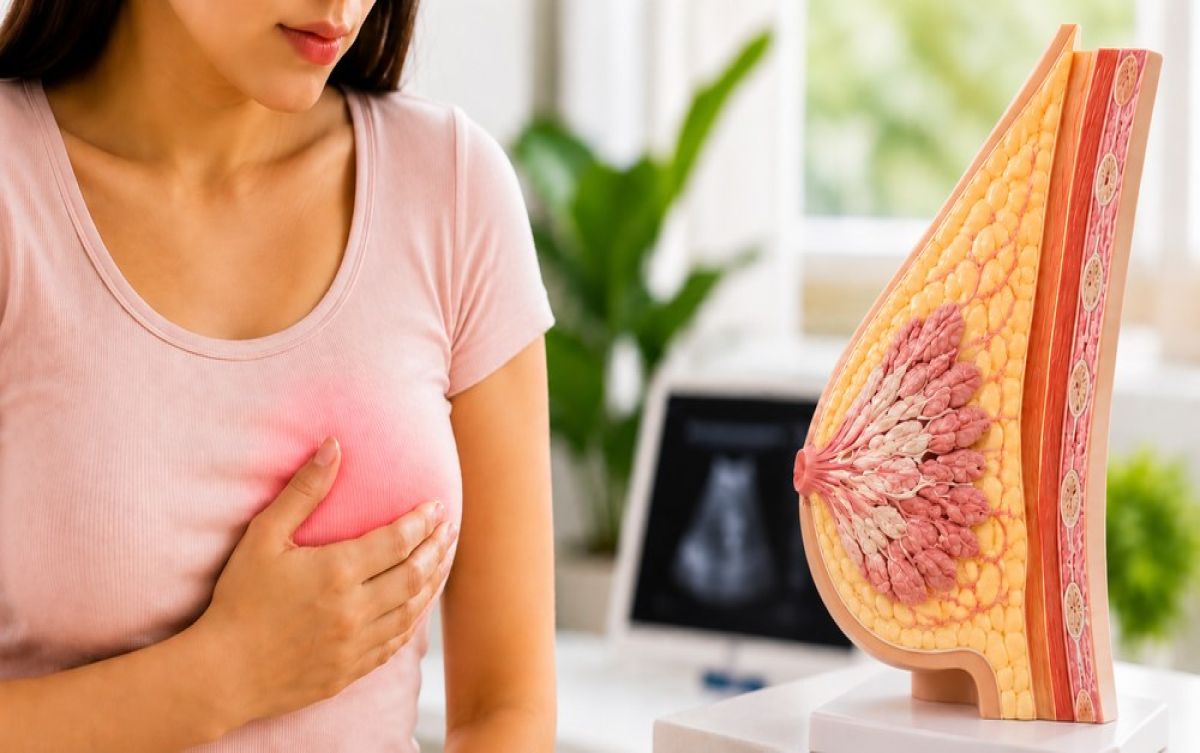
Persistent breast pain is one of those symptoms that patients often minimise and doctors occasionally dismiss. It does not show up on a mammogram. It rarely points to cancer. It tends to get labelled as hormonal or fibrocystic and sent away with the advice to take evening primrose oil and see how it goes.
This approach leaves a significant number of women in Gurgaon, Delhi, and across the NCR managing pain that has an identifiable and treatable cause. It also misses the subset of patients whose pain is the presenting symptom of a cyst that needs aspiration, an abscess that needs drainage, or periductal mastitis that requires a specific antibiotic and, in some cases, surgical treatment. Dr. Rohan Khandelwal, a leading breast specialist in Gurgaon, approaches breast pain not as a default non-diagnosis but as a symptom that deserves proper evaluation.
The Hormonal Underpinning of Cyclical Breast Pain
Cyclical mastalgia, the breast pain that worsens in the days before menstruation, is driven by the interplay of oestrogen and progesterone on breast ductal and stromal tissue. In the luteal phase, elevated progesterone causes ductal dilatation and stromal oedema. In women who are sensitive to these hormonal shifts, this produces a fullness, heaviness, and tenderness that can range from mild background discomfort to pain that affects sleep and movement.
The outer upper quadrants of both breasts are typically most affected, and the pain characteristically resolves within a day or two of the period starting. This cyclical pattern is the most important feature to establish, as it confirms the hormonal mechanism and guides treatment.
First-line management includes lifestyle adjustments, caffeine reduction, a well-fitting supportive bra, and anti-inflammatory medications for severe episodes. When these are insufficient, evening primrose oil (gamolenic acid) has reasonable evidence behind it for cyclical pain, though the effect size is modest. Bromocriptine and danazol are used in refractory cases but carry side effect profiles that limit their long-term use. The important point is that cyclical mastalgia is manageable, and patients should not simply be told to wait it out.
Non-Cyclical Pain: Where the Diagnosis Gets More Interesting
Non-cyclical breast pain does not track the menstrual cycle. It may be constant, episodic, or triggered by specific positions or movements. It tends to be unilateral and localised, and this specificity is actually a diagnostic aid. When a patient can point to a single spot that hurts, there is usually something at that location worth investigating.
Common causes of localised, non-cyclical breast pain include a cyst under tension, a fibroadenoma with rapid growth, periductal mastitis, fat necrosis following minor trauma or surgery, and a benign phyllodes tumour. In each case, imaging localises the source and dictates the management. Anti-inflammatory medications can mask the pain without addressing the underlying condition, which is why persistent non-cyclical pain that does not respond to simple measures warrants a clinical review and ultrasound.
Breast Cysts: What Happens When They Keep Coming Back
A straightforward breast cyst is easy to manage: confirm it on ultrasound, aspirate it if it is symptomatic, check the fluid if it is bloody or clinically atypical, and follow up. Modern breast cyst treatment focuses on accurate diagnosis, symptom relief, and preventing recurrence where possible. Most patients never think about that cyst again. But a meaningful proportion of patients experience recurrence; the cyst refills, sometimes within weeks.
Recurrent cysts are not necessarily sinister, but they deserve a more structured approach. Repeat aspiration is reasonable for a second occurrence. If the cyst refills a third time, particularly if it remains symptomatic, excision may be considered to remove the cyst wall entirely and prevent further recurrence. Complex cysts, defined by the presence of internal septations, thick walls, mural nodules, or solid components, should not simply be aspirated and discharged. They require histopathological assessment because a minority harbour significant pathology.
| Cyst Type | Appearance on Ultrasound | Management | Follow-up Needed |
|---|---|---|---|
| Simple cyst | Anechoic, thin walls, no septations | Aspiration if symptomatic | Routine |
| Complicated cyst | Low-level internal echoes | Aspiration, fluid analysis | Short interval re-imaging |
| Complex cyst | Solid components, thick walls, vascularity | Core biopsy required | Based on biopsy result |
| Recurring simple cyst | Refills after 2 or more aspirations | Consider surgical excision | Post-excision review |
Periductal Mastitis: The Breast Condition Most People Have Never Heard Of
Periductal mastitis is an inflammatory condition of the subareolar ducts that does not affect breastfeeding women exclusively. In fact, non-lactational periductal mastitis predominantly affects women in their thirties and forties who smoke, and it represents one of the most challenging benign breast conditions to manage because of its strong tendency to recur.
The condition begins with inflammation around the large ducts beneath the nipple, progresses to breast abscess formation, and can develop into a chronic sinus that discharges from the areolar edge. Unlike a straightforward lactational abscess, periductal mastitis-related abscesses do not resolve with a single course of antibiotics. They tend to recur because the underlying ductal abnormality, often accompanied by squamous metaplasia of the duct lining, persists.
Successful management requires broad-spectrum antibiotics covering both aerobic and anaerobic organisms, careful drainage of any abscess under ultrasound guidance, and in cases of chronic or recurrent sinus formation, surgical excision of the affected duct segment. Cessation of smoking is not optional advice in this context; it is a meaningful clinical intervention, since smoking is directly implicated in the ductal damage that drives the condition.
Why Breast Abscess in Non-Lactating Women Needs a Different Approach
Lactational abscesses form in the context of milk stasis and infection, typically within the first few weeks of breastfeeding. The bacteriology is usually Staphylococcus aureus; antibiotics are effective early on, and drainage is curative. Non-lactational abscess in women who are not breastfeeding has a different profile entirely.
Non-lactational abscesses are more likely to be polymicrobial, often involving anaerobes alongside aerobes. They are more likely to recur after drainage alone. They require culture-guided antibiotic selection rather than standard empirical therapy. And the underlying cause must be investigated: periductal mastitis, a foreign body, a pilonidal-type process, or rarely, an underlying malignancy presenting with secondary infection.
Drainage of a non-lactational abscess should be image-guided where possible to avoid damaging the nipple-areolar complex. A small catheter left in situ for continuous drainage performs better than single-point needle aspiration for larger collections. The histology of the abscess wall should always be examined.
Getting to the Actual Answer
Managing persistent breast pain, recurring cysts, or recurrent abscesses effectively requires identifying the specific underlying cause, not applying the same intervention repeatedly and expecting different results. Dr. Rohan Khandelwal consults across Gurgaon and Delhi NCR and takes a structured diagnostic approach to breast symptoms that do not resolve with initial treatment.
Patients seeking breast pain treatment in Gurgaon or breast pain treatment in Delhi NCR often benefit from a detailed clinical assessment combined with targeted imaging to identify the exact source of symptoms. Whether the concern is persistent pain, a recurring cyst, or a suspected breast abscess, early evaluation can help prevent complications and unnecessary anxiety.
For patients searching for the best doctor for breast lump in Gurugram, specialist evaluation is particularly important when symptoms persist despite initial treatment. If your breast condition keeps returning, a specialist consultation is the right next step.
Frequently Asked Questions
Yes. Musculoskeletal causes, including costochondritis and intercostal muscle strain, can produce unilateral chest wall pain that feels like it originates in the breast. Clinical examination, including careful palpation of the chest wall and ribs, usually differentiates this from genuine breast pathology.
A cyst that forms or enlarges rapidly can be acutely painful due to the tension within the sac. This kind of sudden, localised pain in a previously asymptomatic area warrants an urgent ultrasound. Aspiration typically provides immediate relief.
Recurrent breast abscesses are not normal. They suggest an underlying condition, such as periductal mastitis, that has not been adequately treated. A specialist review, including imaging of the subareolar region and assessment for an underlying ductal abnormality, is necessary.
Breast pain itself is not a risk factor for breast cancer and is present in fewer than ten percent of breast cancer diagnoses. However, any new, persistent, or unexplained breast pain should be evaluated clinically, particularly if it is non-cyclical or associated with any palpable change.